Manufacturing Guides
Plasma Cutting for Thick Plate: When It Beats Flame and Laser
Plasma cutting wins on mid-thickness steel plate: faster than flame, cheaper than laser. Learn where each process fits and what to ask your supplier before ordering.
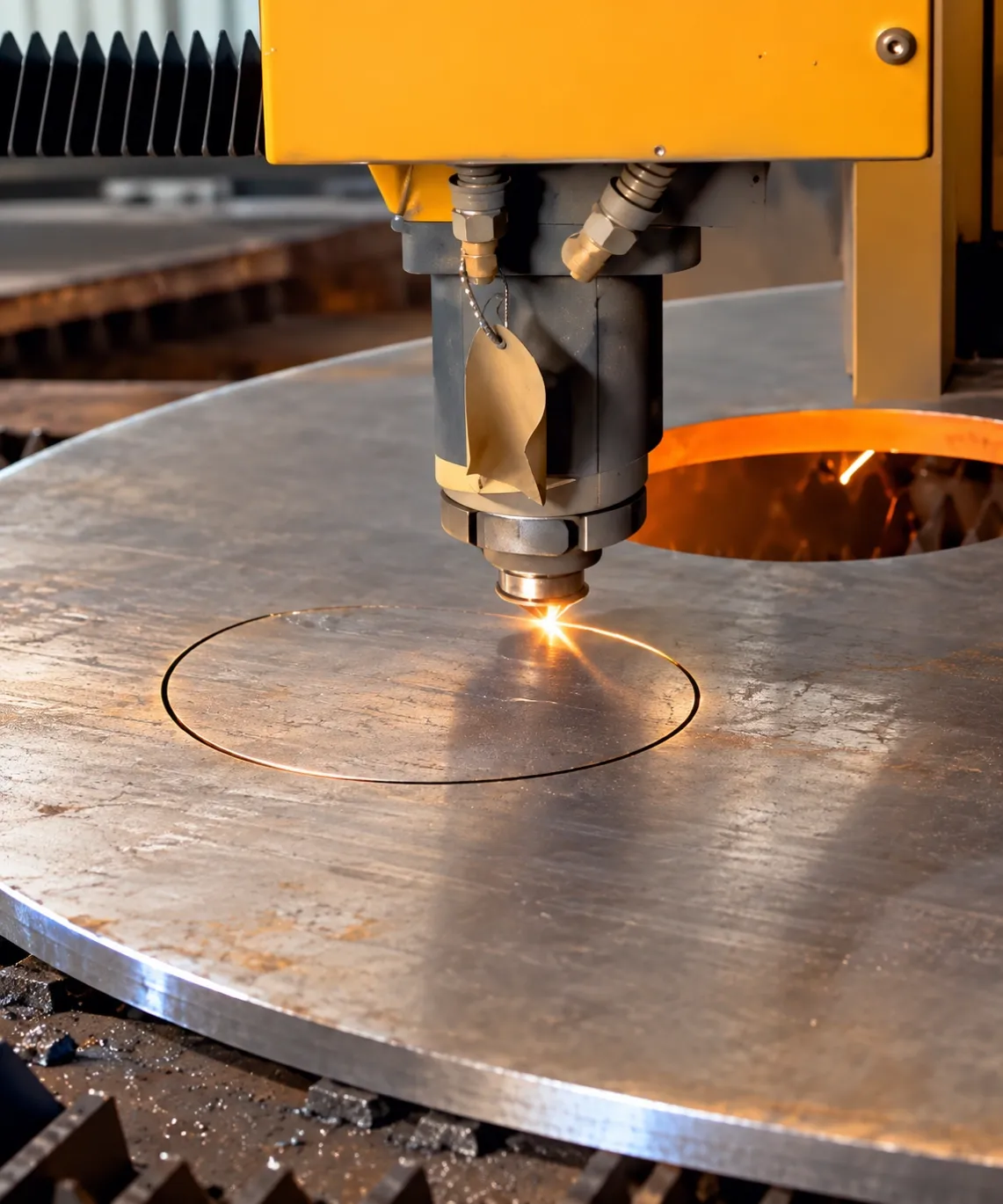
For carbon steel plate roughly 6 to 50 mm thick, plasma cutting is usually the fastest and cheapest, beating flame on speed and laser on cost. Above that range, flame takes over; below it, laser wins on precision. The right choice depends on thickness, material, and edge quality.
This guide fits buyers choosing a cutting process for a specific part, not shops buying a machine. It gives typical industry ranges, not a supplier's guaranteed capability, so confirm the numbers that matter against your drawing and a test cut before you order. The ranges below come from published process guides; your supplier's equipment decides the real limits.
How Thick Can Plasma Cutting Actually Cut?
This is the first question buyers ask, and it has three different answers. A plasma source is rated by its clean cut, its pierce capacity, and its severance cut, and these are not the same number.
The clean cut, sometimes called the rated cut, is the thickest plate the machine cuts at a useful speed with a clean, nearly square edge. The pierce capacity is the thickest plate the torch can pierce from the top, and on a CNC table almost every part starts with a pierce, so this is the number to plan around. Pierce capacity is roughly half to two thirds of the edge-start figure. The severance cut is the absolute thickest plate the arc can get through at very low speed, with a rough edge that needs grinding. Treat it as an emergency figure, not a production figure.
As a rough guide for mild steel, a 45 amp source cuts about 10 to 12 mm well, an 85 amp source about 20 to 25 mm, a 125 amp source about 32 to 38 mm, and a 200 amp source about 50 mm. High-definition plasma holds good edge quality to about 50 mm on carbon steel, and larger conventional systems can sever plate to 100 mm or more, but the edge at that thickness needs secondary work. Stainless steel and aluminium cut thinner than mild steel on the same source, so if your job is mostly stainless, ask for a test cut on your grade. Always ask a supplier which of the three numbers they are quoting. A supplier who answers with a pierce rating and a clean-cut rating is giving you a usable answer.
Plasma vs Flame: Where Does Plasma Win?
Flame cutting, also called oxy-fuel cutting, has cut heavy plate for more than a century, and it still owns the very thick end of the range. It handles carbon steel from about 6 mm to several hundred millimetres thick, and its equipment costs the least of the three processes. Its limits are just as clear. It works only on carbon and low-alloy steel, because the process depends on the iron oxidising. It cannot cut stainless steel or aluminium. It is slow, it leaves a wide heat-affected zone, and thin plate distorts under its heat.
Plasma wins against flame in the middle of the range, roughly 6 to 50 mm on carbon steel. It is several times faster than flame at these thicknesses, it puts far less heat into the plate so parts stay flatter, and its heat-affected zone is considerably narrower. It also cuts any electrically conductive metal, so stainless steel and aluminium are in scope, and it tolerates rusted, painted, or mill-scale plate far better than laser. Plasma is the right call when your plate sits in that middle band, your parts need a reasonable edge without a second operation, and you have mixed materials on the same job.
Flame wins when the plate is very thick, roughly above 50 mm, and the edge can be rough because the part will be machined or ground afterwards anyway. It also wins on long straight cuts on heavy carbon steel, where speed matters less than the low cost of the cut. If a supplier proposes flame for 12 mm plate with a weld-ready edge, ask what secondary work the price includes. The cut may be cheap and the grinding expensive.
Plasma vs Laser: Where Does Plasma Win?
Laser cutting gives the cleanest, most accurate cut of the three processes. Tolerances run typically 0.1 to 0.8 mm depending on thickness and machine, the kerf is narrow, and the heat-affected zone is the smallest of the three. It is the right process for thin plate, intricate profiles, and small holes. Its weakness is thickness. Cutting speed falls sharply as plate thickness rises, and laser is most economical for thin and medium plate, generally up to about 25 mm on carbon steel. It also needs a clean surface, because rust and scale interfere with the beam.
Plasma wins against laser once the plate is thick enough that the laser slows down and its cost per part climbs. As a rule of thumb, a fibre laser is faster on thin plate, the two processes pull level at around 12 to 16 mm, and above about 20 mm plasma wins on cost. Plasma equipment also costs less to install, and it handles plate in worse surface condition.
Laser wins when the part needs tight tolerance, fine detail, or small holes relative to the plate thickness, and when the edge must be ready to use with no finishing. If your drawing calls for a hole smaller than the plate is thick, plasma will taper it and leave a divot at the lead-in, so that hole belongs on a laser, a drill, or a waterjet. A common buyer mistake is to choose by headline cutting speed alone. Compare cost per usable part instead, including any grinding, deburring, or machining the edge still needs. A laser edge that needs no finishing can be cheaper than a plasma edge that needs an hour of grinding, and a plasma edge that already meets the drawing is cheaper than a laser edge you paid a premium for.
What Edge Quality Should You Expect From Plasma?
Edge quality is where plasma jobs most often disappoint, and almost always because the expectation was never written down. Four things decide whether a plasma-cut edge is acceptable, and each one can be specified in the RFQ.
First, bevel. Every thermal cut leaves some edge angle, and laser leaves the least, followed by plasma, then flame. High-definition plasma holds about 1 to 3 degrees of bevel, and conventional air plasma about 3 to 10 degrees. State the maximum bevel your part allows. Second, dross. Molten metal can stick to the bottom edge, and heavy dross has to be ground off. Ask whether dross removal is included in the price. Third, the heat-affected zone. Plasma hardens the edge on medium-carbon and alloy steels over a depth of roughly 0.5 to 3 mm, and air or nitrogen cutting can leave a nitrided skin that causes weld porosity unless it is ground back. If the edge will be welded, say so in the RFQ, and ask whether the edge needs grinding before welding. If the edge will be drilled or tapped, say that too, because a hardened plasma-cut edge is unpleasant to drill. Fourth, holes. As a working rule, a plasma-cut hole holds its size when its diameter is at least the plate thickness. Smaller holes taper and are usually drilled instead. Put the hole rule on the drawing rather than leaving the supplier to guess.
None of this makes plasma a poor process. It makes it a process whose edge needs a written acceptance standard. The cheapest quote is often the one that left the edge standard out.
Which Materials Can Plasma Cut, and Which Can It Not?
Plasma cuts any electrically conductive metal. Carbon steel, stainless steel, and aluminium all cut, with different gases and different edge results. Oxygen gives the fastest cut and the cleanest edge on carbon steel. Nitrogen or an argon-hydrogen mix limits oxidation on stainless steel and aluminium. Flame cutting, by contrast, cuts only carbon and low-alloy steel. Laser cuts all common metals but struggles with highly reflective metals and dirty surfaces.
What plasma cannot cut is anything non-conductive. Glass, ceramics, and most plastics cannot carry the arc, so those jobs belong on a waterjet or a mechanical process. Very thin sheet under about 3 mm can also be a poor fit for plasma, because the heat warps it. And for heat-sensitive, hardened, or work-hardened parts, or for edges that must be burr-free with no heat-affected zone, a cold process such as abrasive waterjet is the honest recommendation.
What to Ask Your Supplier Before You Order
A short set of questions in the RFQ prevents most plasma cutting problems, and the answers tell you more about the supplier than any brochure does. Start with the material and thickness, and ask for the pierce rating and the clean-cut rating on that exact grade, not a catalogue maximum. Ask what tolerance and bevel angle the supplier will guarantee, and whether dross removal is included in the price. Say what happens to the edge next, welding, drilling, painting, or nothing, and ask what preparation that requires. Ask how holes smaller than the plate thickness will be handled, and whether a test cut on your material is possible before the full order runs, because capacity figures are quoted for ideal conditions and real results depend on plate condition, gas purity, consumable wear, and operator skill. Finally, send the drawing, not just the dimensions. A drawing shows the holes, the edge requirements, and the weld preparations that a dimension list hides, and it is what lets a supplier confirm the job against its actual equipment rather than a general claim.
Frequently Asked Questions
How thick can plasma cut?
For carbon steel, high-definition plasma cuts with good edge quality to about 50 mm, and larger systems can sever thicker plate with a rougher edge. The number that matters for production is the pierce rating, roughly half to two thirds of the edge-start rating, because most CNC parts start with a pierce.
Is plasma cutting cheaper than laser cutting?
On thin plate, no, laser is faster and often cheaper per part. On plate above about 20 mm, plasma is usually cheaper per usable part, because laser speed falls sharply with thickness. Compare the finished cost, including any edge finishing, not the cutting speed alone.
Can plasma cutting cut stainless steel?
Yes, plasma cuts stainless steel and aluminium as well as carbon steel. Expect a lower practical thickness than the mild steel figure on the same machine, and a rougher edge, so ask for a test cut on your grade.
The Short Version
Choose plasma when the plate is in the middle band, roughly 6 to 50 mm, the material may include stainless or aluminium, and the edge it produces already meets the drawing. Choose flame when the plate is very thick carbon steel and the edge will be machined afterwards. Choose laser when the plate is thin and the part needs tight tolerance or fine detail. And whichever process you choose, write the edge standard into the RFQ, because the edge is where the cost of a wrong choice shows up.
If you are sourcing plasma-cut plate parts, send your drawing, material grade, plate thickness, and quantity through the VEHOON inquiry form. The team will review the cutting requirements and recommend the appropriate manufacturing process for your part.