Manufacturing Guides
Post-Weld Machining: Why It Matters for Critical Dimensions
Why machining after welding is often necessary for accurate heavy steel components, and how to specify it in the RFQ.
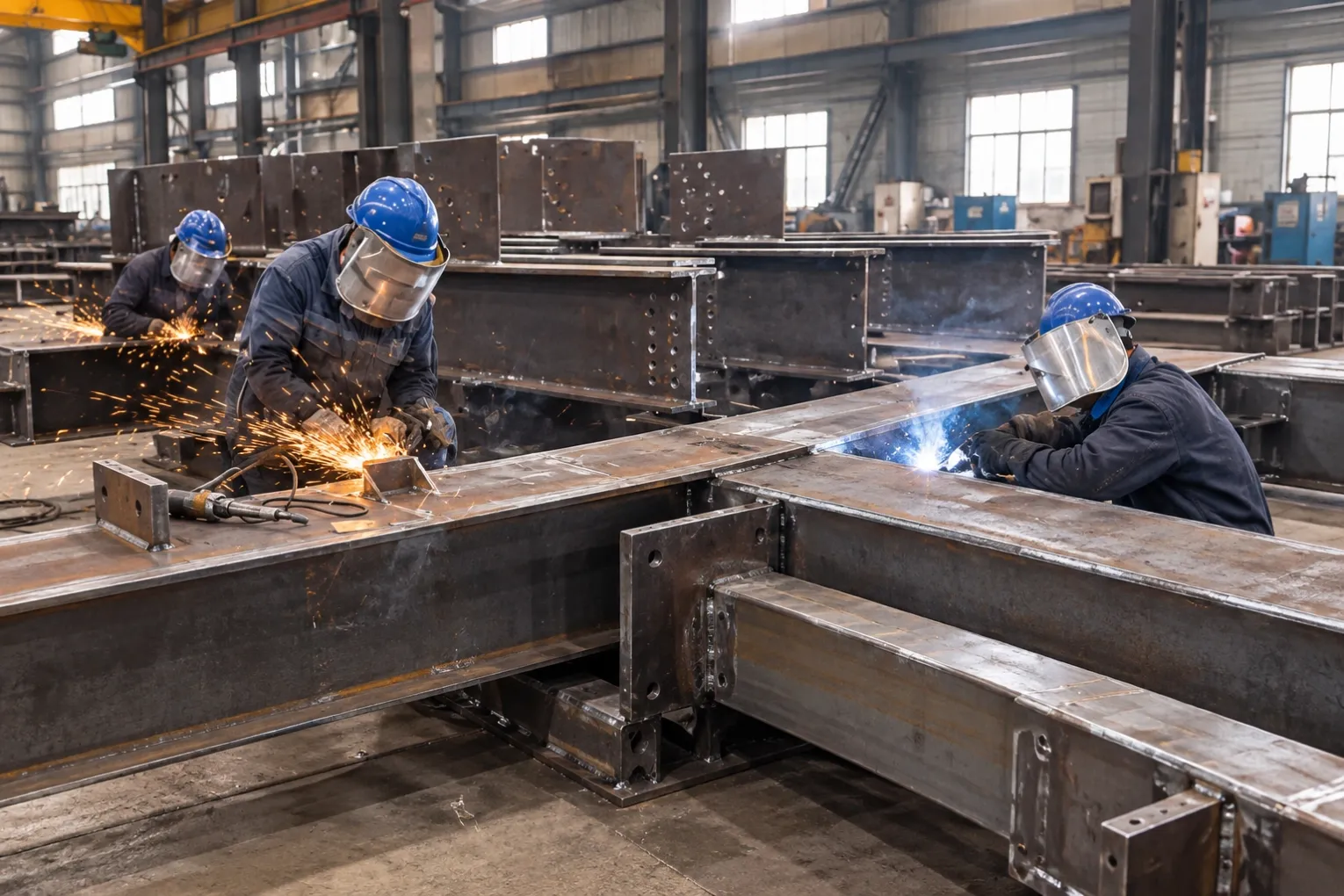
Few decisions in heavy fabrication cause as much rework as the question of when a component is machined. Machine it before welding and the welding moves it. Weld it first and the surfaces that control fit, alignment and mounting have to be produced in a second operation. For a frame, base or large welded structure, the answer is almost always that the critical features are finished after welding — and the cost of a component is decided long before that, by whether the drawing and the sequence were planned for it.
This guide explains what welding does to a component, why pre-machining cannot carry the final requirement on its own, where post-weld machining is normally needed, how to plan the sequence, and what to specify so that the finishing operation is possible when it is reached.
What Welding Does to a Component
Welding introduces localised heating and cooling, and the metal around a weld contracts as it cools. On a fabricated component the result is distortion, which shows up in several distinct ways:
- Angular movement between welded members — a joint that closes or opens as it cools, so that two parts that were set at an angle no longer sit at it.
- Bending or bowing along a fabricated section — heat applied unevenly, for example more weld on one side of a neutral axis than the other, curves the whole member.
- Shrinkage that changes overall dimensions — the component comes out slightly different in length or width from the sum of its parts, because each weld draws material together.
- Movement of features relative to each other — a hole, a face or a bore that was correct before welding is no longer in the same relationship to the others afterwards.
The important characteristic of this distortion is that it accumulates. A single weld moves the metal around it by a small amount; a fabrication with many welds, or with long continuous welds, adds those small amounts together, so that a small movement at each joint becomes a significant deviation across the finished part. This is why a fabricated component is less accurate than the individual parts it was built from, and why the movement cannot be predicted from the drawing alone — it depends on how much weld, in what order, with what restraint.
Welding also leaves residual stress in the component. That stress is not visible, but when material is removed during machining, the balance changes and the part can move again as the stress redistributes. On a component where the finishing operation removes a significant amount of material, this is worth planning for rather than discovering during machining.
Why Machining Before Welding Is Not Always Enough
Machining a feature before welding establishes it accurately at that point in the process. It is a real and useful step — pre-machining produces clean, accurate joint faces, gives a starting reference, and can reduce the amount of finishing work later. What it cannot do is carry the final requirement for a feature that welding will move.
The reason is straightforward: accuracy achieved before welding is accuracy at an earlier point in the process. Welding then acts on the part. For a feature that must align with another component, or that sets a mounting plane, or that must be square to a datum established during assembly, the accuracy from the pre-machining stage is unlikely to survive fabrication. Machining after welding removes the accumulated movement and establishes the final relationship between features at the point where it will hold.
The practical consequence is a question of stock. For post-weld machining to be possible, the fabricated component has to arrive at the machining stage with enough material on the controlled surfaces to be cleaned up and brought to size. If the welder leaves the surface to finished size, there is nothing for the machining to remove, and the route has to be reconsidered — sometimes by adding weld metal, sometimes by changing the design. Allowing the stock is a decision made at the drawing stage, not at the machine. How these operations fit into a broader route is covered in CNC machining and welding: one route or two.
Where Post-Weld Machining Is Usually Needed
Post-weld machining is commonly specified on the features whose function depends on their position and accuracy after fabrication:
- Mounting surfaces on machine frames and equipment bases — the faces that transmit load and set the level of the component, where flatness determines how well it seats.
- Bores and bearing seats on welded structures — where alignment between bores, or between a bore and a face, has to hold on the finished assembly.
- Interface dimensions between mating components — where this component has to match another that is made separately, and the two have to fit.
- Surfaces on which other equipment will be mounted — where a motor, gearbox or cylinder is bolted on and the mounting has to be true.
- Features that must be parallel or perpendicular to a datum established after fabrication — where the reference itself only exists once the assembly is welded.
For components where only the overall size matters, post-weld machining may not be necessary at all. The controlling question is not "is this a welded part" but "which surfaces carry a requirement that welding can disturb" — and applying finishing to surfaces that do not need it adds cost without adding function, the same logic that governs how tolerances are specified and surface finish.
In practice these surfaces are produced on a vertical machining centre or by CNC milling, and the component is commonly delivered as a machined welded assembly rather than as a raw fabrication.
Planning the Sequence
The decision is about sequence as much as about process, and it is best made from the drawing rather than from habit. A practical approach:
- Identify the features that control fit and alignment — the mounting faces, bores, interfaces and reference surfaces, rather than every dimension on the drawing.
- Establish whether welding will affect each of them — which features are in a region that the welds will move, and which are far enough away to be unaffected.
- Where welding will affect a feature, plan its machining after welding — and machine it as part of the finishing operation, not before fabrication.
- Allow machining stock on those surfaces in the fabricated condition — enough material to remove the movement and reach the finished size.
- Confirm the datum structure can be established on the welded part — the reference the finishing operation works from has to exist, and be accessible, after fabrication.
- Fix the position of any heat treatment in the sequence — if the component is stress-relieved or heat-treated, that step moves the part too, and the machining has to come after it, not before.
Allowing enough stock at the fabrication stage is essential, and it is the step most often missed. If the welded component arrives at machining with insufficient material to clean up, the route has to be reconsidered — and correcting it after the part is welded is far more expensive than planning it before.
What to Specify in the RFQ
Because post-weld machining has to be planned, the enquiry should state it rather than leave it to be inferred. Useful points to include:
- Which features require post-weld machining — listed explicitly, and distinguished from the surfaces that are acceptable as welded.
- Tolerances and datums for those features — the requirement and the reference it is measured from, so that both can be met and checked.
- Whether machining is required in one setup or more — which affects both the achievable accuracy and the cost.
- Any heat treatment step and its position in the sequence — stress relief, normalising or other treatment, and whether machining comes before or after it.
- Inspection requirements for the finished features — what is to be verified on the completed component.
Stating the delivery condition is equally useful. A component may be required as a welded structure, a machined weldment, or a fully assembled item, and the price and the route are different for each. Stating which surfaces are machined and which are as-welded removes the ambiguity that otherwise has to be resolved after the quote. How to prepare drawings for a steel fabrication RFQ covers the general checklist.
Inspection After Post-Weld Machining
Inspection should confirm the features that the machining operation was intended to control, and it should be carried out on the finished component rather than inferred from the parts that went into it. Checking the individual parts before welding says nothing about the welded assembly, because welding is exactly what moves them.
Depending on the project, verification may involve dimensional checks against the drawing, verification of the critical interfaces and the alignment between them, and surface inspection of the machined faces. Where a datum was established on the welded part, that setup is part of the result and is worth recording. Documented inspection — a record of what was measured, against what requirement, and what was found — can be provided where the project requires it, and is the honest answer to how the finished component was confirmed.
Common Problems and How to Avoid Them
Most problems with post-weld machining trace back to something that was decided, or not decided, before the part was made:
- Insufficient stock. The fabricated part arrives at machining with no material to remove on the controlled surface, because the requirement was never passed to the fabrication stage. Avoided by marking the stock allowance on the drawing.
- A datum that cannot be established. The requirement is written against a reference that does not exist, or is not accessible, on the welded component. Avoided by confirming the datum on the finished part at the drawing stage.
- Sequence locked too early. The route is set before the requirements are clear, so a heat treatment or a second welding operation is placed after the machining that should have followed it. Avoided by fixing the sequence after the controlled features are identified.
- A requirement on a surface that welding will move. An accuracy is specified on an as-welded surface, where it cannot be guaranteed. Avoided by deciding, surface by surface, what condition each one will be in at delivery.
- Residual stress released during machining. A significant amount of material is removed, the part moves, and the finish is lost. Avoided by considering the stress state and the amount to be removed before the operation is planned.
Summary
Welding and accuracy pull in different directions. Post-weld machining resolves the conflict on the features that matter — those whose position and alignment decide whether the component works — provided the sequence and the stock allowance are planned from the start rather than discovered at the machine.
To discuss a component that needs machining after welding, send your drawings, assembly requirements and delivery condition to sales@vehoon.com for a manufacturing review. We will review where machining should sit in the route and confirm the requirements for your project.
Common Questions
What is post-weld machining, and when is it actually required?
Post-weld machining means cutting the critical features after the weld is complete, rather than before it. It is required wherever a welded assembly has to hold a dimensional or geometric requirement that welding would otherwise destroy: mounting faces that must be flat and parallel, bores that must be aligned, locating surfaces that set the position of other components, and sealing faces. It is not required on parts where the welded condition is good enough, and adding it unnecessarily adds cost without adding function. The decision belongs on the drawing, where the surfaces that need machining can be identified before the part is made.
What is a machined weldment, and how does it differ from a welded fabrication?
A weldment is a part built by welding several pieces together. A machined weldment is the same thing taken one stage further: after welding, specific surfaces are cut on a machine tool so the assembly meets dimensional and geometric requirements that the welded state cannot hold. The difference is not cosmetic. A welded fabrication is judged against fabrication tolerances, which are relatively open because welding distortion is inherent. A machined weldment is judged against machining tolerances on the machined surfaces, and against fabrication tolerances everywhere else. Mixing the two categories in a single specification is a common reason quotes come back incomparable.
How is a welded part inspected after post-weld machining?
Inspection after post-weld machining has to establish a datum on the finished part, because the machined faces are the only reliable reference once welding has moved the assembly. In practice that means the part is set up, supported at defined points, and the datum is confirmed before any other measurement is taken. The measurements that matter are the machined surfaces against drawing requirements, and the inspection record should state what was measured, what was required, what was found, and how the datum was established. For a large component the method itself has to suit the accuracy being claimed, which is why the inspection method is better agreed at quotation than at delivery.